

EXPERIENCED PERSONAL INJURY ATTORNEYS












Illinois Nursing Home Hoyer Lift Accident Lawyers
Dedicated Attorneys for Residents Injured During Transfers
Hoyer lifts and other mechanical patient lifts are designed to make it safer for nursing home staff to transfer residents who cannot safely stand, walk, or reposition themselves without assistance. When used correctly, these devices can reduce the physical demands placed on caregivers while helping protect vulnerable residents from falls and other transfer-related injuries.
But a Hoyer lift is only as safe as the equipment, staff, procedures, and supervision surrounding its use. A resident can be seriously injured if a sling is improperly positioned, the wrong equipment is used, the lift is defective or poorly maintained, staff members fail to follow the resident’s care plan, or a nursing home attempts a transfer without the number of caregivers required.
For an elderly or disabled nursing home resident, a fall from even a short distance can result in a broken hip, traumatic brain injury, spinal injury, dislocation, internal injuries, or permanent disability. The consequences can be particularly severe because many nursing home residents already have osteoporosis, limited mobility, neurological conditions, or other health problems that make recovery more difficult.
When a nursing home Hoyer lift accident occurs, families should not automatically assume it was an unavoidable accident. In some cases, the evidence may reveal inadequate staffing, poor training, failure to follow a care plan, equipment problems, or neglect.
As John J. Malm explains, “When a nursing home resident suffers a serious injury during a mechanical lift transfer, families need to know whether the accident was truly unavoidable or whether inadequate care, staffing, training, or equipment contributed to what happened.”
What Is a Hoyer Lift?
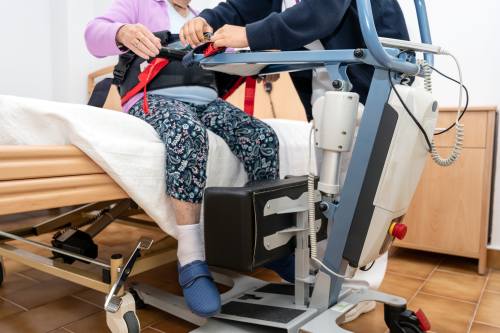
A Hoyer lift is a type of mechanical patient lift used to move a person who has limited mobility. Depending on the model, the device generally consists of a wheeled base, a lifting mechanism, a boom or arm, and a sling that supports the resident during the transfer. Hoyer lifts may be used to move residents between locations such as:
- A bed and a wheelchair
- A bed and a shower or bathing chair
- A wheelchair and a toilet
- A bed and a stretcher
- A chair and another appropriate surface
The equipment is particularly important for residents who cannot safely bear weight or participate adequately in a transfer.
A properly performed transfer typically requires staff to assess the resident, select the appropriate sling and equipment, position the sling correctly, secure the resident, operate the lift according to manufacturer and facility procedures, and monitor the resident throughout the movement.
The resident’s individual care plan can also be critical. If the care plan requires two staff members to perform a mechanical-lift transfer, for example, using only one employee may create an unsafe situation.
How Hoyer Lift Accidents Happen
Hoyer lift accidents can have many causes. Sometimes the problem involves an individual employee’s failure to follow established procedures. In other situations, the underlying problem may involve facility-wide issues such as inadequate staffing, insufficient training, poor equipment maintenance, or management’s failure to enforce safety policies.
Common causes include:
- Improper sling selection
- Incorrect sling placement
- Failure to secure the sling properly
- Using the wrong type or size of sling
- Attempting a transfer with too few staff members
- Failure to follow the resident’s care plan
- Improper positioning of the lift
- Failure to lock or appropriately position equipment when required
- Defective or poorly maintained equipment
- Failure to inspect the lift before use
- Inadequate employee training
- Failure to supervise inexperienced staff
- Rushing a transfer because of staffing shortages
- Attempting to manually move a resident when a mechanical lift is required
- Failure to respond appropriately when equipment malfunctions
A serious Hoyer lift accident may therefore be evidence of more than an isolated mistake. Investigating the circumstances can help determine whether the facility had adequate systems in place to protect the resident.
Why Hoyer Lift Falls Can Be So Serious
Falls are a major threat to older adults. The CDC identifies falls as the leading cause of injury among adults age 65 and older. In 2024, the age-adjusted fall death rate for older adults was 78.4 deaths per 100,000, representing a 21% increase from 2018.
The potential consequences are especially significant in nursing homes. A resident who falls from a sling or lift may suffer:
- Hip fractures
- Arm or leg fractures
- Pelvic fractures
- Spinal fractures
- Shoulder injuries
- Joint dislocations
- Head injuries
- Traumatic brain injuries
- Internal bleeding
- Soft-tissue injuries
- Nerve damage
- Chronic pain
- Loss of mobility
- Permanent disability
- Psychological trauma
The CDC reports that older adults experience approximately three million emergency-department visits and about one million hospitalizations each year because of falls. Nearly 319,000 older adults are hospitalized annually for hip fractures.
For a nursing home resident, the consequences can extend well beyond the initial hospitalization. A previously mobile resident may become wheelchair-dependent after a fracture. A resident who was already receiving rehabilitation may experience a significant setback. In severe cases, complications following a fall can contribute to a decline in overall health or even death.
Statistics Show the Seriousness of Nursing Home Falls
Nursing home residents are particularly vulnerable to falls and fall-related injuries. A recent U.S. Department of Health and Human Services Office of Inspector General (OIG) review identified 42,864 falls involving major injury and hospitalization among Medicare-enrolled nursing home residents during the one-year period studied. The OIG also reported that 1,911 residents died while hospitalized following these serious falls, while Medicare and enrollees paid more than $800 million for resulting hospital care.
Even more concerning, a 2025 OIG report found that nursing homes failed to report 43% of falls involving major injury and hospitalization among Medicare-enrolled residents in the resident assessments used for federal quality measures. These statistics are not specific to Hoyer lift accidents. However, they demonstrate the broader danger of falls among nursing home residents and why every serious transfer accident deserves careful scrutiny.
CMS also specifically tracks the percentage of nursing home residents experiencing one or more falls with major injury. The agency describes major fall injuries as potentially including fractures, joint dislocations, and head injuries.
Improper Staffing Can Contribute to Hoyer Lift Accidents
One of the most important questions after a Hoyer lift accident is whether the appropriate number of employees were present. Mechanical lifts are not necessarily intended to be operated by one employee in every circumstance. The appropriate number of caregivers can depend on the resident, the equipment, the manufacturer’s instructions, the facility’s policies, and the resident’s individualized care plan. If a resident’s care plan requires two caregivers and only one employee attempts the transfer, that discrepancy can be highly significant.
A recent Illinois nursing home inspection illustrates the potential consequences. At a Chicago-area facility, a resident who was supposed to be transferred with a Hoyer lift and assistance from two staff members was instead manually transferred by a single CNA because the lift reportedly was not working and another staff member was unavailable. The resident fell and suffered a leg fracture requiring surgery.
The facts of any individual inspection or incident must be evaluated independently, but the example demonstrates why staffing and equipment availability can become central issues in a Hoyer lift injury investigation.
Failure to Follow the Resident’s Care Plan
A nursing home resident’s care plan can provide important evidence about the level of assistance required for transfers. The plan may identify:
- Whether the resident can bear weight
- Whether a mechanical lift is required
- What type of lift should be used
- What type of sling should be used
- Whether one or two caregivers are necessary
- Whether the resident has a history of falls
- Whether the resident has cognitive or physical limitations
- Special precautions required during transfers
If employees knowingly disregard those instructions, the resulting accident may raise serious questions about the adequacy of the resident’s care. A family should therefore obtain and preserve the resident’s care plan, particularly if the facility’s explanation of the accident conflicts with the documented transfer requirements.
Equipment Failure and Hoyer Lift Maintenance
Not every Hoyer lift accident is caused by employee negligence. Equipment failure can also be a factor. Mechanical lifts contain components that require proper inspection and maintenance. Depending on the device, relevant components can include the sling, straps, hooks, wheels, brakes, hydraulic or electrical systems, batteries, controls, and lifting mechanism.
A nursing home should have procedures for identifying equipment problems and removing unsafe equipment from service. Warning signs that equipment may have been improperly maintained can include:
- A lift that repeatedly malfunctions
- Damaged or frayed sling material
- Broken or damaged straps
- Problems with controls
- Unusual noises
- Battery or charging problems
- Hydraulic problems
- Missing components
- Wheels or casters that do not operate properly
- Equipment that is visibly damaged
If staff knew that a lift was defective but used it anyway, the circumstances should be investigated.
Training and Competency Matter
Operating a Hoyer lift requires more than simply knowing how to move the controls. Employees should understand how to select and position the appropriate sling, secure the resident, operate the equipment, and respond if something goes wrong. Training issues may become particularly important when:
- A newly hired employee was involved
- An employee had not completed required training
- The facility had no documentation of competency
- Employees were using equipment differently from facility policy
- Staff members provided conflicting accounts of the procedure
- Employees admitted they were unfamiliar with the equipment
A facility’s training records, competency evaluations, policies, and employee statements may help establish whether staff were adequately prepared to perform the transfer.
Signs That a Hoyer Lift Accident May Involve Neglect
A Hoyer lift accident does not automatically mean a nursing home is legally responsible. However, certain circumstances can warrant a more thorough investigation. Families should pay attention if:
- The nursing home cannot clearly explain what happened
- Staff members provide inconsistent accounts
- The facility failed to notify the family promptly
- The resident’s medical records do not match the facility’s explanation
- The care plan required more assistance than was provided
- Employees were not properly trained
- The equipment was allegedly broken or unavailable
- The nursing home had known staffing shortages
- There were prior complaints or incidents involving transfers
- The resident suffered an unexplained fracture or other serious injury
- The facility failed to preserve relevant records or evidence
These circumstances do not, by themselves, establish liability. They are reasons to investigate further.
Illinois Nursing Home Residents Have Legal Protections
Illinois law provides important protections for nursing home residents. Under the Illinois Nursing Home Care Act, residents have rights concerning their treatment and care, and the law expressly prohibits an owner, licensee, administrator, employee, or agent of a facility from abusing or neglecting a resident.
Illinois law also provides a potential civil remedy when a nursing home’s owner or licensee is responsible for an intentional or negligent act or omission by an employee or agent that injures a resident. Section 3-601 of the Nursing Home Care Act addresses this liability. The Act also provides remedies for violations of residents’ rights.
The Illinois Courts’ materials concerning the Nursing Home Care Act explain that the statute provides nursing home residents with a private cause of action for damages and other relief when applicable statutory requirements are violated. The exact legal theory and available damages depend on the facts of the case.
What Families Should Do After a Hoyer Lift Accident
If a loved one is seriously injured during a Hoyer lift transfer, obtaining medical care should be the immediate priority. Once the resident is medically stable, families should begin documenting what happened. Important steps may include:
- Obtain copies of the resident’s medical records.
- Request the resident’s care plan and transfer instructions.
- Document the date, time, and location of the accident.
- Photograph visible injuries.
- Ask who witnessed the transfer.
- Request information about the lift and sling involved.
- Preserve photographs of damaged equipment when possible.
- Document hospitalizations, surgeries, and rehabilitation.
- Keep records of medical bills and other expenses.
- Ask whether an incident report was completed.
- Preserve communications with the nursing home.
- Consult an experienced Illinois nursing home injury attorney.
Families should also be cautious about accepting the facility’s initial explanation without asking questions. A statement that an accident was simply a “fall” does not explain why the fall happened.
What Evidence Can Be Important in a Hoyer Lift Case?
An investigation may involve significantly more than the resident’s medical chart. Potential evidence includes:
- The resident’s care plan
- Nursing notes
- CNA notes
- Medication records
- Incident reports
- Witness statements
- Staffing records
- Employee schedules
- Training and competency records
- Facility policies
- Equipment inspection records
- Maintenance records
- Manufacturer information
- Photos and videos
- Hospital records
- Ambulance records
- Prior complaints or citations
- State inspection records
- Electronic medical-record audit trails
The nursing home’s records can be especially important because they may establish what employees knew about the resident’s transfer requirements before the accident.
Frequently Asked Questions About Nursing Home Hoyer Lift Accidents
Can a nursing home be liable if a resident falls from a Hoyer lift?
Potentially. Liability depends on the facts. A nursing home may face liability if an employee or facility failed to use reasonable care, violated applicable requirements, disregarded the resident’s care plan, improperly used equipment, failed to provide adequate assistance, or otherwise contributed to the injury.
Is a Hoyer lift accident considered nursing home neglect?
Not automatically. An accident may occur without negligence or neglect. However, unsafe transfers, inadequate staffing, failure to follow a care plan, inadequate training, or failure to maintain equipment can potentially constitute evidence of negligent care or neglect depending on the circumstances.
What if the nursing home says the resident’s injury was unavoidable?
Families should not necessarily accept that explanation without investigating. A serious injury may have multiple contributing causes. Records concerning staffing, training, equipment, care plans, and the circumstances of the transfer may provide a more complete picture.
What injuries can result from Hoyer lift accidents?
Potential injuries include fractures, hip injuries, spinal injuries, head trauma, traumatic brain injuries, dislocations, nerve injuries, soft-tissue injuries, and permanent loss of mobility. The severity depends on the circumstances of the fall and the resident’s health.
What if the nursing home did not use the Hoyer lift specified in the care plan?
That can be important evidence. If a care plan required a mechanical lift or specified a particular transfer procedure, investigators should determine why staff deviated from those instructions and whether that deviation contributed to the resident’s injury.
Can families sue a nursing home for a Hoyer lift accident in Illinois?
Potentially. Illinois law provides protections and remedies for nursing home residents, including provisions addressing negligent acts or omissions by facility employees or agents. The viability of a particular claim depends on the evidence and circumstances.
How long do I have to bring a Hoyer lift nursing home injury claim in Illinois?
The applicable deadline can depend on the type of claim, the circumstances of the injury, the identity of the parties, and other legal considerations. Because missing a statute of limitations can prevent recovery, families should discuss a potential claim with an Illinois attorney as soon as reasonably possible.
The Top Illinois Nursing Home Injury Lawyers at John J. Malm & Associates Investigate Hoyer Lift Accidents
A Hoyer lift is intended to help protect nursing home residents, not expose them to preventable harm. When a resident is dropped, improperly transferred, or injured because staff failed to follow the resident’s care plan, the family deserves answers. The difference between an unavoidable accident and preventable nursing home neglect often lies in the records. Care plans, staffing schedules, training documentation, equipment-maintenance records, incident reports, medical records, and witness statements can reveal what happened before, during, and after a Hoyer lift accident.
If your loved one was injured during a Hoyer lift transfer at an Illinois nursing home, contact John J. Malm & Associates for a free consultation. Our experienced Illinois nursing home injury attorneys can investigate the circumstances, identify potential evidence, evaluate whether the facility violated its duties, and pursue the compensation and accountability your family may deserve.
Do not allow a serious nursing home injury to be dismissed as simply an accident. If your loved one suffered a fracture, head injury, spinal injury, or other serious harm during a Hoyer lift transfer, contact John J. Malm & Associates today to discuss your family’s legal options.