- Free Consultation: (630) 527-4177 Tap Here to Call Us
















Types of Major Back Injuries from Car Accidents: What Victims Need to Know


A serious car accident can cause far more than temporary soreness or muscle stiffness. The tremendous forces generated during a collision can damage the spine, fracture vertebrae, rupture spinal discs, tear supporting ligaments, and even cause permanent spinal cord injuries. For some accident victims, these injuries require extensive medical treatment, multiple surgeries, months of rehabilitation, and lifelong changes to their ability to work and perform everyday activities.
Back injuries are particularly concerning because the spine protects the spinal cord, which carries essential nerve signals between the brain and the rest of the body. Damage to the spinal structures can result in chronic pain, reduced mobility, numbness, weakness, and, in the most severe cases, paralysis.
As Naperville car accident attorney John J. Malm explains:” A serious back injury can change the course of someone’s life. Our responsibility is to understand the full impact of that injury, hold negligent drivers accountable, and fight for the compensation our clients need to move forward.”
How Car Accidents Cause Serious Back Injuries
The human spine is designed to provide structural support while allowing the body to bend, twist, and move. However, it has limits. During a collision, the sudden acceleration, deceleration, twisting, and compression forces can exceed those limits.
Even when a vehicle has airbags and modern safety features, occupants can experience significant trauma. The body may be thrown forward, backward, or sideways, placing tremendous stress on the cervical, thoracic, and lumbar regions of the spine. Several types of collisions are particularly associated with serious back injuries:
- Rear-end collisions: The sudden forward-and-backward movement can strain spinal muscles, ligaments, and cervical discs.
- Head-on collisions: Violent deceleration can compress vertebrae and damage spinal discs.
- T-bone accidents: Side-impact forces can cause twisting injuries, fractures, and damage to spinal structures.
- Rollover accidents: Multiple impacts and unusual body positioning can cause severe spinal fractures and spinal cord trauma.
- High-speed collisions: Greater collision forces increase the potential for serious injuries involving multiple spinal structures.
Some injuries are immediately apparent, while others develop symptoms over hours or days. Accident victims should never assume that back pain following a collision is insignificant.
1. Herniated and Ruptured Spinal Discs
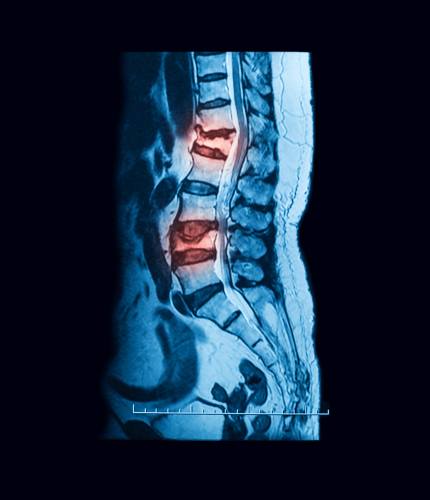
One of the more significant injuries following a car accident is a herniated spinal disc. Spinal discs are soft, cushion-like structures located between the vertebrae. They absorb shock, distribute pressure, and allow the spine to move.
Each disc has a tough outer layer and a softer interior. When collision forces place excessive pressure on a disc, its outer layer may weaken or tear, allowing the inner material to protrude. A herniated disc can irritate or compress nearby nerves, producing symptoms that extend beyond the injured area. Common symptoms include:
- Persistent neck or back pain.
- Pain radiating into the arms, shoulders, buttocks, or legs.
- Numbness or tingling in the extremities.
- Muscle weakness.
- Difficulty bending, lifting, or twisting.
- Pain that worsens with certain movements or prolonged sitting.
Herniated discs frequently occur in the cervical spine (neck) and lumbar spine (lower back). Severe cases may require epidural steroid injections, physical therapy, or surgical procedures such as a discectomy or spinal fusion. A herniated disc can also interfere with a person’s ability to work, exercise, drive, and participate in normal family activities.
2. Spinal Compression Fractures
A spinal compression fracture occurs when a vertebra partially collapses under excessive pressure. These injuries can happen when a driver’s or passenger’s body is forcefully thrown against a seatbelt, steering wheel, dashboard, or other part of the vehicle. Compression fractures are especially concerning because they can alter the normal structure and alignment of the spine. Symptoms may include:
- Sudden, severe back pain.
- Pain that becomes worse when standing or walking.
- Reduced spinal mobility.
- Tenderness around the injured vertebra.
- Changes in posture or spinal curvature.
Depending on the severity of the fracture, treatment may involve bracing, medication, physical therapy, or surgery. Some patients require vertebroplasty or kyphoplasty, procedures intended to stabilize certain compression fractures. More severe fractures can cause permanent spinal deformity, chronic pain, and nerve damage.
3. Burst Fractures of the Vertebrae
Burst fractures are among the most dangerous spinal injuries associated with high-impact car accidents. A burst fracture occurs when a vertebra is subjected to extreme compression and breaks into multiple fragments. Unlike a relatively stable compression fracture, a burst fracture can cause bone fragments to spread outward into the spinal canal.
When these fragments damage or compress the spinal cord, the victim may experience serious neurological complications. Potential symptoms and complications include:
- Severe back pain.
- Loss of sensation or numbness.
- Muscle weakness.
- Difficulty walking.
- Loss of bladder or bowel control.
- Partial or complete paralysis.
Burst fractures frequently require emergency medical evaluation and may necessitate spinal stabilization surgery. Depending on the injury, surgeons may use rods, screws, or other hardware to restore spinal stability. Recovery can involve extensive rehabilitation and long-term medical care.
4. Spinal Cord Injuries
A spinal cord injury (SCI) is one of the most devastating consequences of a serious automobile accident. The spinal cord is a bundle of nerves that travels through the spinal canal and communicates between the brain and the rest of the body. When trauma damages the spinal cord, the resulting impairment can affect movement, sensation, breathing, and other essential bodily functions.
According to the National Institute of Child Health and Human Development (NICHD), motor vehicle crashes account for approximately 40.4% of spinal cord injuries reported in its cited historical data, making automobile accidents a leading cause of these injuries. The severity of a spinal cord injury depends on its location and extent. Two major classifications include:
- Complete spinal cord injuries: These injuries result in a complete loss of motor function and sensation below the level of the injury.
- Incomplete spinal cord injuries: These injuries leave some motor function or sensation below the affected area, although substantial impairment may remain.
A spinal cord injury can result in paraplegia, affecting movement and sensation in the lower body, or tetraplegia (quadriplegia), affecting all four limbs and potentially the trunk. Victims may require emergency surgery, intensive rehabilitation, mobility equipment, home modifications, and lifelong medical assistance. The financial consequences can be substantial, particularly when an individual loses the ability to return to their previous occupation.
5. Spinal Fracture-Dislocations
A fracture-dislocation occurs when a vertebra breaks and moves out of its normal position relative to the surrounding spinal structures. These injuries are particularly dangerous because displacement can damage the spinal cord, nerve roots, ligaments, and surrounding tissues. Fracture-dislocations are commonly associated with high-energy trauma, including rollover accidents and severe head-on collisions. Potential consequences include:
- Severe spinal instability.
- Nerve compression.
- Spinal cord damage.
- Chronic pain.
- Loss of mobility.
- Permanent neurological impairment.
Treatment often requires surgery to realign and stabilize the spine. Surgeons may use instrumentation, including metal rods and screws, to hold the vertebrae in the appropriate position while healing occurs.
A 2014 study examining spinal injuries in motor vehicle crashes found that rollover collisions had particularly high rates of spinal fracture-dislocations and severe spinal cord injuries. The research highlights the significant risks associated with violent vehicle impacts.
6. Spinal Ligament Tears and Soft Tissue Injuries
Not all serious back injuries involve broken bones or damaged discs. The ligaments surrounding the spine provide essential stability by connecting bones and limiting excessive movement. During a collision, these ligaments can stretch beyond their normal range or tear. A severe ligament injury can create spinal instability and may occur alongside fractures or disc injuries. Common symptoms include:
- Persistent back or neck pain.
- Muscle spasms.
- Swelling and tenderness.
- Reduced range of motion.
- Pain when twisting or bending.
- Difficulty maintaining normal posture.
Although some ligament injuries improve with conservative treatment, severe tears may require surgical stabilization. It is important to distinguish a minor muscle strain from a significant ligament injury. Imaging studies and a thorough medical examination may be necessary to identify the underlying damage.
7. Spinal Stenosis Aggravated by a Car Accident
Spinal stenosis occurs when the spaces within the spinal canal narrow, potentially placing pressure on the spinal cord or surrounding nerves. Although spinal stenosis frequently develops over time because of age-related changes, a traumatic automobile collision can aggravate an existing condition or cause additional structural damage that worsens nerve compression. Symptoms may include:
- Chronic back pain.
- Numbness or tingling in the arms or legs.
- Weakness.
- Difficulty walking or standing for extended periods.
- Pain that radiates into the extremities.
In some cases, accident victims who previously experienced few symptoms develop significant limitations following a collision. Treatment depends on the underlying cause and severity. Physical therapy, medication, injections, and surgical decompression may be recommended.
An important issue in these cases is determining whether the collision caused a new injury or aggravated a preexisting condition. Illinois law generally allows injured individuals to pursue compensation when another party’s negligence aggravates a previously existing medical condition.
8. Spondylolisthesis and Spinal Instability
Spondylolisthesis occurs when one vertebra slips forward relative to the vertebra beneath it. Although the condition can develop gradually, traumatic forces from a serious collision can cause or aggravate spinal instability. When vertebrae move out of their normal alignment, they can irritate nearby nerves and produce significant pain. Symptoms may include:
- Persistent lower back pain.
- Pain radiating into the legs.
- Muscle tightness.
- Numbness or tingling.
- Difficulty standing or walking.
- Reduced flexibility.
Severe cases may require spinal fusion surgery to stabilize the affected vertebrae. For accident victims, documenting the condition before and after the collision can be important when establishing whether the crash caused or worsened the spinal problem.
Symptoms That May Indicate a Serious Back Injury
Following a car accident, back pain should not automatically be dismissed as ordinary soreness. Certain symptoms may indicate a serious injury involving the spine or spinal cord. Accident victims should seek prompt medical evaluation if they experience:
- Severe or worsening back pain.
- Pain that radiates into the arms or legs.
- Numbness or tingling.
- Weakness in the legs or arms.
- Difficulty walking or maintaining balance.
- Loss of bladder or bowel control.
- Numbness in the groin or saddle region.
Loss of bladder or bowel control, new paralysis, or rapidly developing weakness requires emergency medical attention. Some spinal injuries are not immediately apparent. Delayed symptoms do not necessarily mean an injury is minor.
How Are Major Back Injuries Diagnosed After a Car Accident?
Accurately diagnosing a spinal injury is important for determining the appropriate treatment and preventing additional complications. Medical providers may use several diagnostic tools, including:
- X-rays: Identify certain fractures, dislocations, and alignment abnormalities.
- CT scans: Provide detailed images of spinal bones and help identify complex fractures.
- MRI scans: Evaluate spinal discs, ligaments, nerve roots, spinal cord injuries, and soft tissue damage.
- Neurological examinations: Assess sensation, reflexes, muscle strength, and movement.
According to the National Institute of Neurological Disorders and Stroke (NINDS), MRI can help identify spinal trauma, herniated discs, ligament injuries, and other abnormalities that may affect the spinal cord. Early diagnosis can be critical, particularly when an injury involves spinal instability or neurological impairment.
Long-Term Consequences of Serious Back Injuries
Major back injuries can permanently change an accident victim’s life. Even after treatment, some individuals experience chronic pain, restricted mobility, and an inability to return to their previous activities. Long-term consequences may include:
- Chronic pain and recurring muscle spasms.
- Permanent nerve damage.
- Reduced mobility and flexibility.
- Partial or complete paralysis.
- Multiple spinal surgeries.
- Long-term prescription medication use.
- Inability to return to work.
- Depression, anxiety, and emotional distress.
- Significant medical expenses and rehabilitation costs.
For individuals with catastrophic spinal injuries, the need for future medical treatment, assistive devices, personal care, and home modifications can continue for decades. These consequences should be considered when evaluating the full financial and personal impact of a car accident.
Compensation for Serious Back Injuries in Illinois Car Accident Claims
When another driver’s negligence causes a serious back injury, an injured person may have the right to pursue compensation through a personal injury claim. The value of a claim depends on the nature of the injury, medical treatment, long-term prognosis, lost income, and other relevant evidence. Potential damages may include:
- Past and future medical expenses.
- Hospitalization and surgical costs.
- Physical and occupational therapy.
- Prescription medications and medical equipment.
- Lost wages.
- Loss of future earning capacity.
- Pain and suffering.
- Disability and disfigurement.
- Loss of normal life.
For victims with serious spinal injuries, it is important to understand the full extent of their medical condition before resolving an insurance claim. Settling too early can leave an injured person without adequate compensation for future medical needs.
FAQ: Major Back Injuries from Car Accidents
What is the most serious back injury from a car accident?
A spinal cord injury is among the most serious back injuries because it can cause permanent neurological damage, paralysis, and loss of independence. Burst fractures and fracture-dislocations can also be catastrophic, particularly when they damage the spinal cord.
Can a car accident cause a herniated disc?
Yes. The sudden compression, twisting, and impact forces associated with a collision can damage spinal discs. A herniated disc may cause back pain, radiating pain, numbness, tingling, and muscle weakness.
How long does it take to recover from a serious back injury?
Recovery depends on the injury. Some patients improve within weeks or months, while others require surgery, extensive rehabilitation, or lifelong medical care. Spinal cord injuries and severe vertebral fractures can result in permanent impairment.
Can back injuries from car accidents cause permanent disability?
Yes. Severe spinal fractures, spinal cord injuries, and significant nerve damage can cause permanent disabilities, including paralysis, chronic pain, and loss of mobility.
What if my back injury did not cause symptoms immediately after the accident?
Some back injuries produce delayed symptoms. Swelling, inflammation, and nerve irritation may develop over time. Accident victims should seek medical evaluation when symptoms appear, even if they initially felt fine.
Can I file an Illinois personal injury claim if a car accident aggravated a preexisting back condition?
Yes. Illinois law generally recognizes claims involving the aggravation of preexisting conditions. You may pursue compensation when another driver’s negligence worsens an existing spinal condition, provided the applicable legal requirements are satisfied.
What evidence is important in a serious back injury claim?
Important evidence may include accident reports, medical records, MRI and CT imaging, surgical records, physician opinions, employment records, witness statements, and documentation of how the injury affects daily activities.
Contact the 5-Star Rated Illinois Car Accident Lawyers at John J. Malm & Associates About a Serious Back Injury
A major back injury can affect every aspect of a person’s life. From herniated discs and spinal fractures to devastating spinal cord injuries, the consequences of a serious automobile collision can extend far beyond the initial emergency room visit. Victims may face years of treatment, lost earning capacity, chronic pain, and uncertainty about their future.
At John J. Malm & Associates, we understand the physical, financial, and emotional challenges that accompany serious car accident injuries. Our attorneys have over 95 years of combined litigation experience representing injured individuals and families throughout DuPage, Kane, Cook, Will, Kendall, and surrounding Illinois counties. We understand the importance of thoroughly investigating collisions, obtaining medical evidence, working with appropriate experts, and establishing the full extent of our clients’ injuries and future needs.
If you or someone you love suffered a serious back injury in a car accident, you do not have to navigate the aftermath alone. The insurance company may focus on minimizing its financial responsibility, but your medical needs, lost income, and long-term well-being deserve careful consideration. Contact our firm after an accident to discuss your rights and options with an experienced Illinois car accident attorney. John J. Malm & Associates offers free consultations and is prepared to help you pursue the compensation you deserve.