- Free Consultation: (630) 527-4177 Tap Here to Call Us
















Do Police Reports Include Cellphone Use In Car Accidents?


Cellphones have become an unavoidable part of modern life. Drivers use them for navigation, communication, entertainment, work, and countless other purposes. Unfortunately, the same devices that help people stay connected can become a serious safety hazard when they take a driver’s attention away from the road.
A new study from the Insurance Institute for Highway Safety (IIHS) suggests that the danger of cellphone use behind the wheel may be even greater than traditional crash statistics indicate. According to the IIHS, police crash reports substantially undercount cellphone use in the moments leading up to motor vehicle crashes. In fact, researchers found that cellphone use before crashes was undercounted in police reports by a factor of at least seven.
The findings raise important questions for drivers, lawmakers, safety advocates, and people injured in car accidents. If distracted driving is not accurately identified after a car accident, the true scope of the problem may be hidden, and proving that a distracted driver caused an accident can become more challenging for injured victims.
“A distracted driver may not admit what they were doing in the moments before a crash, and the police report may not tell the whole story. When someone is seriously injured, it is important to conduct a thorough investigation and pursue every available source of evidence to determine what really happened.” — John J. Malm, Naperville car accident attorney
What Did the New IIHS Study Find?
The IIHS study examined anonymized cellphone data collected through safe-driving applications supported by Cambridge Mobile Telematics (CMT). Researchers linked crashes detected through telematics technology with police-reported crashes in four states between 2021 and 2024.
The resulting sample included nearly 17,000 linked crashes. The findings were striking. According to telematics data:
- Drivers were using cellphones in the 30 seconds before impact in 7% of single-vehicle crashes.
- Drivers were using cellphones in the 30 seconds before impact in 8% of two-vehicle crashes.
- Police reports for those same crashes recorded cellphone use in less than 1% of cases.
- Researchers concluded that police reports undercounted cellphone use before crashes by a factor of at least seven.
- Police reports recorded the same type of cellphone activity identified through telematics data in only three out of nearly 17,000 linked crashes.
The study does not establish that cellphone use caused every crash in which phone activity was detected. Researchers also could not determine whether the cellphone user was legally at fault for the collision. However, the research provides compelling evidence that traditional crash reports may fail to capture how frequently drivers are interacting with their phones immediately before an accident.
Why Police Reports Often Miss Cellphone Use
One of the biggest challenges with distracted driving is that the evidence can disappear almost immediately. After a crash, a driver may put their phone away, lock the screen, or deny that they were using the device. Unlike skid marks, vehicle damage, or other physical evidence, cellphone distraction may leave little visible evidence at the crash scene.
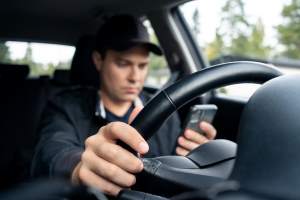
The IIHS identified several reasons cellphone use may be overlooked in police investigations. Modern smartphone activity is often difficult for witnesses to observe, and drivers may be reluctant to admit that they were distracted before a crash.
The National Highway Traffic Safety Administration has also recognized the problem. According to NHTSA, pre-crash distractions often leave no evidence for law enforcement to observe, and drivers frequently do not admit they were distracted. Reporting practices also vary between jurisdictions, making distracted-driving data inconsistent from one location to another. This means that a police report that does not mention cellphone use does not necessarily prove that the driver was not distracted.
The Most Dangerous Phone Activity May Not Be Talking or Texting
When people think about distracted driving, they often picture a driver sending a text message. Texting remains extremely dangerous because it combines three forms of distraction:
- Visual distraction — taking your eyes off the road.
- Manual distraction — taking your hands off the wheel.
- Cognitive distraction — taking your mind away from driving.
However, the new IIHS research shows that distracted driving has become much broader. Researchers found that active cellphone manipulation, such as tapping, swiping, or otherwise handling the device, was more common before crashes than either hand-held or hands-free calls.
That matters because today’s drivers may use their phones for much more than calls and text messages. A driver may be:
- Checking social media.
- Changing a song or podcast.
- Looking at a navigation app.
- Watching a video.
- Reading an email.
- Responding to a work message.
- Shopping online.
- Using a rideshare or delivery app.
- Checking notifications.
- Opening or closing an application.
Even a few seconds of distraction can have devastating consequences. The IIHS notes that looking away from the road for just two seconds doubles the risk of a crash or near-crash event.
NHTSA similarly warns that reading or sending a text can take a driver’s eyes off the road for approximately five seconds. At 55 miles per hour, that is comparable to traveling the length of a football field without watching the roadway.
Distracted Driving Statistics May Only Tell Part of the Story
National distracted-driving statistics are alarming even before considering the possibility of significant underreporting. According to NHTSA, 3,208 people were killed in crashes involving distracted drivers in 2024. Those crashes accounted for approximately 8% of all traffic fatalities that year. NHTSA also reported that 315,167 people were injured in distracted-driving crashes in 2024. Of the people killed in distraction-affected crashes during 2024, 437 died in crashes involving cellphone use identified in police reports.
But the new IIHS research demonstrates why those numbers should be viewed carefully. If cellphone use is frequently missed during crash investigations, official statistics may significantly underestimate the role phones play in serious and fatal collisions.
NHTSA has acknowledged this limitation. Its research notes that estimates based on naturalistic observation have found distraction may be involved in a much larger percentage of crashes than police-reported data suggests. One federal analysis estimated that distraction was involved in 29% of all crashes, resulting in approximately 10,546 fatalities, 1.3 million nonfatal injuries, and $98.2 billion in economic costs in 2019.
These different estimates do not mean that every crash involving distraction can be proven through traditional crash reporting. Instead, they demonstrate just how difficult it is to accurately measure behavior that occurs in the seconds before a collision.
Passive Cellphone Use Can Also Create Serious Risks
The IIHS study also examined what researchers called “passive” cellphone use. This included situations where the driver’s phone screen was unlocked, even if the telematics system did not detect the driver actively touching the phone. Navigation applications may account for some of this activity. However, an unlocked screen does not necessarily mean the driver was safely focused on the road.
Drivers may glance repeatedly at navigation directions, maps, videos, or other screen-based applications. The IIHS found that passive cellphone use was approximately as common as active use in the 30 seconds before impact.
The problem is particularly concerning because smartphones increasingly integrate with vehicles through systems such as Apple CarPlay and Android Auto. These systems may reduce some forms of distraction, but drivers can still become visually or cognitively distracted when interacting with screens and digital information.
The IIHS also reported that nearly 25% of drivers surveyed in a separate study admitted to watching a video on their phone while driving at least once during the previous 30 days. Technology may change, but the fundamental safety principle remains the same: drivers need to pay attention to the road.
Why Underreporting Matters After a Car Accident
For someone injured by another driver, identifying the true cause of a crash can be critical. A police report is an important piece of evidence, but it is not always the final answer to what happened. If a report does not mention cellphone use, additional investigation may still reveal that a driver was distracted.
Depending on the circumstances, evidence of distracted driving may include:
- Cellphone records.
- Vehicle telematics data.
- Safe-driving app data.
- Infotainment system records.
- Witness statements.
- Traffic or surveillance camera footage.
- Dash camera footage.
- Social media activity.
- Accident reconstruction evidence.
- Statements made by the driver after the crash.
- Data from electronic devices or vehicle systems.
Every accident is different, and evidence must be preserved quickly. Video footage may be deleted, witnesses can become difficult to locate, and digital information may require formal legal action to obtain. This is one reason why a thorough investigation can be especially important after a serious car accident involving catastrophic injuries or wrongful death.
How Telematics Could Change Distracted Driving Investigations
Telematics technology may provide a clearer picture of what happens before crashes. Telematics systems can collect information about vehicle movement and, in some cases, cellphone activity. The IIHS study used data capable of identifying hand-held calls, hands-free calls, and physical manipulation of a phone.
This technology could potentially help researchers better understand:
- How often drivers use phones before crashes.
- What types of phone activity are most common.
- Whether distracted-driving laws are effective.
- Which driver behaviors create the greatest risks.
- Why official crash statistics may undercount cellphone involvement.
However, telematics data also has limitations. The IIHS researchers could not determine whether cellphone use caused a particular crash or whether the driver using the phone was at fault. The data also did not identify which specific apps were being used. Still, the study demonstrates that technology may reveal information that traditional crash investigations miss.
Stronger Cellphone Laws May Help Reduce Crashes
The IIHS reports that 21 states, including Illinois, prohibit drivers from holding a phone. These broader hands-free laws are generally easier to enforce than laws that prohibit only specific activities, such as texting. An officer does not necessarily need to determine whether a driver was texting, watching a video, or using an application. The officer only needs to observe the driver holding the phone.
According to the IIHS, research indicates that broader restrictions on manipulating electronic devices are more effective than laws narrowly focused on specific activities. The rapid development of smartphone technology presents an ongoing challenge for lawmakers. New applications and forms of entertainment can create distractions that were not contemplated when earlier distracted-driving laws were written. Ultimately, the safest approach is simple: put the phone away before the vehicle starts moving.
What Should You Do If You Suspect the Other Driver Was Distracted?
If you have been injured in a crash and believe the other driver may have been using a cellphone, taking action promptly can be important. Consider the following steps:
- Seek medical attention for your injuries.
- Call law enforcement and ensure the accident is documented.
- Take photographs and preserve available evidence.
- Obtain names and contact information for witnesses.
- Avoid confronting the other driver about their cellphone.
- Save any photographs, videos, or communications related to the crash.
- Be cautious about giving recorded statements to an insurance company.
- Speak with an experienced Illinois car accident lawyer about investigating the collision.
A serious crash investigation may involve much more than reviewing the police report. An attorney may be able to investigate additional evidence and work to determine whether distraction, speeding, impairment, fatigue, or another form of negligence contributed to the collision.
Frequently Asked Questions About Cellphone Use and Car Accidents
Can a police report be wrong about whether a driver was using a cellphone?
Yes. The new IIHS study found that police reports frequently failed to identify cellphone use detected through telematics data. Police officers often have limited evidence regarding what occurred inside a vehicle immediately before a crash.
Can I still prove distracted driving if the police report does not mention a cellphone?
Potentially. Other evidence may help establish distraction, including cellphone records, video footage, witness statements, vehicle data, and other digital evidence. The available evidence depends on the facts of the specific accident.
Is using GPS while driving considered distracted driving?
Navigation can become a distraction if it causes a driver to take their eyes, hands, or attention away from the road. Drivers should enter destinations and adjust navigation settings before beginning their trip whenever possible.
How many people are killed by distracted driving each year?
According to NHTSA, 3,208 people were killed in crashes involving distracted drivers in the United States in 2024. However, researchers and safety agencies caution that distracted driving is likely underreported.
What is the most dangerous type of cellphone use while driving?
Activities that combine visual, manual, and cognitive distraction can be especially dangerous. Texting and other forms of active cellphone manipulation can require drivers to take their eyes, hands, and attention away from driving.
Can I recover compensation if a distracted driver caused my injuries?
Depending on the circumstances, an injured person may be entitled to seek compensation for medical expenses, lost income, pain and suffering, disability, and other damages. The available compensation depends on the facts of the case and applicable law.
Contact the 5-Star Rated Illinois Car Accident Attorneys at John J. Malm & Associates After a Distracted Driving Accident
The new IIHS study provides an important warning: police reports may not tell the complete story about cellphone use before a crash. When a driver looks down at a phone, taps a screen, watches a video, or becomes distracted by technology, the consequences can change another person’s life in seconds. And because distracted driving can be difficult to identify after an accident, a thorough investigation can be critical.
If you or someone you love has been injured in a car accident involving a suspected distracted driver, the experienced car accident injury attorneys at John J. Malm & Associates are ready to help. Our firm can investigate the circumstances of your crash, preserve important evidence, and fight for the compensation you deserve. Contact John J. Malm & Associates today for a free consultation and learn how our trial-ready personal injury lawyers can help you move forward after a serious accident.