- Free Consultation: (630) 527-4177 Tap Here to Call Us

















Why the Unique Physics of Motorcycle Accidents Makes Them So Deadly


Motorcycles offer riders an unparalleled sense of freedom, but they also provide very little protection when a crash occurs. Unlike occupants of passenger vehicles who are surrounded by seat belts, airbags, and reinforced steel frames, motorcycle riders are directly exposed to the tremendous forces generated during a collision. These forces, governed by the laws of physics, help explain why motorcycle accidents frequently result in catastrophic injuries or fatalities, even at speeds that might produce only minor damage in a passenger vehicle.
According to the National Highway Traffic Safety Administration (NHTSA), motorcyclists are approximately 24 times more likely to die in a crash per vehicle mile traveled than occupants of passenger cars. In Illinois alone, hundreds of motorcyclists lose their lives or suffer life-changing injuries every year despite representing only a small percentage of vehicles on the road.
Understanding the unique physics behind motorcycle crashes helps explain why these accidents are so severe and why injured riders often require extensive medical treatment and significant financial compensation.
“Every motorcycle crash is a lesson in physics. Riders don’t have airbags, steel frames, or seat belts protecting them from the enormous forces generated during an accident. That’s why even crashes that appear moderate can leave victims with life-changing injuries. Our job is to make sure insurance companies understand the true extent of those injuries and the compensation our clients deserve.” — John J. Malm, Naperville Motorcycle Accident Attorney
Motorcycles Offer Virtually No Crash Protection
The most obvious difference between a motorcycle and a passenger vehicle is the lack of a protective structure. When two cars collide, energy is absorbed through:
- Crumple zones
- Airbags
- Seat belts
- Reinforced passenger compartments
- Side-impact protection
Motorcycles have none of these safety systems. Instead, the rider’s body often becomes the primary object absorbing crash energy. This means forces that would normally be dispersed through a vehicle are transferred directly into bones, muscles, ligaments, internal organs, and the brain. Even relatively low-speed impacts can generate tremendous physical forces capable of causing devastating injuries.
Newton’s First Law Explains Why Riders Are Thrown From Their Motorcycles
One of the most important principles involved in motorcycle crashes is Newton’s First Law of Motion, sometimes called the law of inertia. An object in motion remains in motion unless acted upon by an outside force.
Imagine a motorcycle traveling 45 mph. If the motorcycle suddenly strikes another vehicle:
- the motorcycle stops
- the rider does not
Instead, the rider continues traveling forward at approximately 45 mph until striking:
- another vehicle
- the roadway
- a guardrail
- a tree
- another fixed object
Unlike drivers protected by seat belts, motorcyclists are frequently ejected entirely from the motorcycle. This secondary impact often causes far more serious injuries than the initial collision itself.
Speed Dramatically Increases Crash Energy
Perhaps the biggest misconception about motorcycle crashes is that small increases in speed only slightly increase danger. Physics says otherwise.
The amount of kinetic energy involved in a crash is determined by the equation: Kinetic Energy = ½ × Mass × Velocity²
Notice that velocity is squared.
That means:
- Doubling speed creates four times the crash energy.
- Tripling speed creates nine times the energy.
For example:
- A motorcycle traveling 30 mph carries far less crash energy than one traveling 60 mph.
- The rider’s body must absorb much of that additional energy during impact.
This explains why even moderate speeding dramatically increases injury severity. According to NHTSA, speeding remains one of the leading contributing factors in fatal motorcycle crashes.
A Motorcycle’s Small Size Creates Additional Risks
Motorcycles are significantly smaller than passenger vehicles. While this provides excellent maneuverability, it also creates unique hazards. Drivers frequently report that they:
- never saw the motorcycle
- misjudged its speed
- believed it was farther away
- turned left directly into its path
These “looked-but-failed-to-see” crashes occur because the motorcycle presents a much smaller visual profile than a car or truck. The result is often a violent side-impact collision that throws the rider from the bike.
Motorcycle Riders Experience Multiple Impacts
Unlike occupants of passenger vehicles, motorcycle riders rarely experience just one impact. Instead, crashes often involve several separate collisions. A rider may:
- strike another vehicle
- be thrown into the pavement
- slide dozens of feet
- collide with a guardrail
- strike a curb
- hit roadside objects
Each impact transfers additional energy into the body. Every collision increases the likelihood of catastrophic injuries. This phenomenon is one reason motorcycle injuries are often far more severe than automobile accident injuries occurring at similar speeds.
The Human Body Cannot Withstand the Forces Generated in a Motorcycle Crash
The human body is remarkably resilient, but it has physical limits. During a motorcycle accident, the forces generated by sudden deceleration often exceed what bones, muscles, ligaments, and internal organs can tolerate. Unlike occupants inside a passenger vehicle, motorcyclists have no protective cage to absorb impact energy before it reaches their bodies.
When a motorcycle traveling at highway speed suddenly stops, the rider continues moving forward until another object, such as the pavement, another vehicle, a guardrail, or a tree, brings them to a stop. That rapid deceleration places enormous stress on virtually every part of the body.
Common catastrophic injuries include:
- Traumatic brain injuries (TBIs)
- Spinal cord injuries and paralysis
- Multiple fractures
- Pelvic fractures
- Internal organ damage
- Severe road rash requiring skin grafts
- Crush injuries
- Limb amputations
According to the Centers for Disease Control and Prevention (CDC), traumatic brain injuries remain one of the leading causes of death and permanent disability in the United States. While helmets significantly reduce the risk of fatal head injuries, they cannot eliminate the tremendous forces involved in a high-speed motorcycle collision.
Sliding Creates a Second Type of Injury
One characteristic unique to motorcycle crashes is the distance riders often slide after impact. Unlike occupants inside a vehicle, riders frequently separate from the motorcycle and slide across asphalt or concrete before coming to rest. Even when protective riding gear is worn, the friction generated between the body and the roadway can cause devastating injuries. Road rash is much more than a simple scrape. Severe cases may involve:
- Deep tissue damage
- Torn muscles
- Exposed bone
- Nerve injuries
- Infection
- Permanent scarring
The longer the slide, the greater the likelihood that the rider will eventually strike another fixed object, such as a curb, guardrail, utility pole, or parked vehicle. These secondary impacts often produce life-threatening injuries even after the initial collision has ended.
Motorcycles Are Less Stable Than Four-Wheeled Vehicles
Physics also explains why motorcycles are inherently less stable than passenger vehicles. A motorcycle balances on only two narrow contact patches where its tires meet the road. Cars and trucks, by contrast, distribute their weight across four tires, providing significantly greater stability during emergency maneuvers.
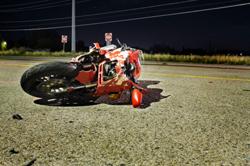
As a result, motorcycles are more vulnerable to:
- Sudden braking
- Sharp cornering
- Gravel or loose pavement
- Wet roads
- Potholes
- Uneven pavement
- Road debris
- Strong crosswinds
A hazard that causes little more than a bump for a passenger vehicle may cause a motorcycle rider to lose control entirely. Because motorcycles rely heavily on traction and rider balance, dangerous road conditions frequently contribute to serious crashes. This is one reason municipalities and property owners may be liable when poorly maintained roads create hazardous riding conditions.
Truck and SUV Collisions Multiply Crash Forces
The laws of physics become even more unforgiving when motorcycles collide with larger vehicles. Commercial trucks can weigh up to 80,000 pounds, while the average motorcycle weighs only 400 to 900 pounds. Passenger SUVs and pickup trucks also outweigh motorcycles by several thousand pounds.
When two objects of dramatically different masses collide, the smaller object generally experiences far greater acceleration and damage. This imbalance explains why motorcycle crashes involving:
- Semi-trucks
- Delivery trucks
- Pickup trucks
- Large SUVs
- Commercial buses
are disproportionately likely to result in catastrophic injuries or fatalities. Higher ride heights on trucks and SUVs also increase the risk that a rider will be thrown underneath the larger vehicle or strike elevated bumpers and front-end structures rather than absorbing the impact lower to the ground.
Frequently Asked Questions About the Physics of Motorcycle Accidents
Why are motorcycle accidents usually more severe than car accidents?
Motorcycle accidents are typically more severe because riders lack the protective features found in passenger vehicles. Cars are equipped with seat belts, airbags, crumple zones, and reinforced passenger compartments that absorb crash energy. Motorcycle riders, however, are exposed directly to the forces of impact. In many crashes, the rider is thrown from the motorcycle and experiences multiple impacts with the roadway, other vehicles, or fixed objects, significantly increasing the risk of catastrophic injury.
Why are motorcyclists thrown from their bikes during a crash?
According to Newton’s First Law of Motion, an object in motion remains in motion until acted upon by another force. When a motorcycle suddenly stops during a collision, the rider’s body continues moving forward at the same speed until it strikes another object. Without a seat belt or enclosed cabin, riders are frequently ejected, resulting in serious injuries.
Does speed really make that much of a difference?
Yes. Crash energy increases exponentially as speed increases. Because kinetic energy is proportional to the square of velocity, doubling a motorcycle’s speed results in approximately four times the crash energy. Even modest increases in speed can dramatically increase the severity of injuries sustained in an accident.
Why do motorcycle riders suffer so many head and spinal injuries?
When riders are thrown from their motorcycles, they often strike the pavement or another object with tremendous force. While helmets significantly reduce the risk of fatal head injuries, they cannot eliminate the violent acceleration and deceleration that cause traumatic brain injuries and spinal cord damage. These injuries often require lifelong medical treatment and rehabilitation.
Are motorcycle accidents more dangerous than passenger vehicle accidents?
Yes. According to the National Highway Traffic Safety Administration (NHTSA), motorcyclists are approximately 24 times more likely to die in a traffic crash per vehicle mile traveled than occupants of passenger vehicles.
Can poor road conditions cause motorcycle crashes?
Absolutely. Motorcycles are much more sensitive to roadway hazards than cars because they balance on only two tires. Hazards that may be minor inconveniences for passenger vehicles can cause a rider to lose control. Dangerous conditions include:
- Potholes
- Loose gravel
- Uneven pavement
- Construction debris
- Oil spills
- Standing water
- Poor roadway maintenance
In some cases, a municipality, contractor, or property owner may be legally responsible for creating or failing to correct these dangerous conditions.
Contact the Experienced Illinois Injury Lawyers at John J. Malm & Associates After a Serious Motorcycle Accident
Motorcycle accidents are unlike any other type of motor vehicle collision. The unique laws of physics mean that riders absorb tremendous crash forces, often suffering catastrophic injuries that require months or even years of recovery. Insurance companies may try to minimize these claims, but the reality is that motorcycle accident victims frequently face overwhelming medical expenses, lost income, and lasting physical and emotional trauma.
At John J. Malm & Associates, we understand both the science behind motorcycle crashes and the legal strategies necessary to build a successful personal injury claim. For more than three decades, John J. Malm has been fighting for injured motorcyclists throughout Illinois, helping clients recover compensation for serious injuries caused by negligent drivers, dangerous road conditions, and other preventable hazards.
If you or someone you love has been injured in a motorcycle accident, don’t wait to protect your rights. Contact John J. Malm & Associates today for a free consultation. We’ll investigate your accident, explain your legal options, deal with the insurance companies on your behalf, and fight to recover the maximum compensation available under Illinois law so you can focus on your recovery.