- Free Consultation: (630) 527-4177 Tap Here to Call Us












2026 Most Dangerous Intersections in Aurora, Illinois


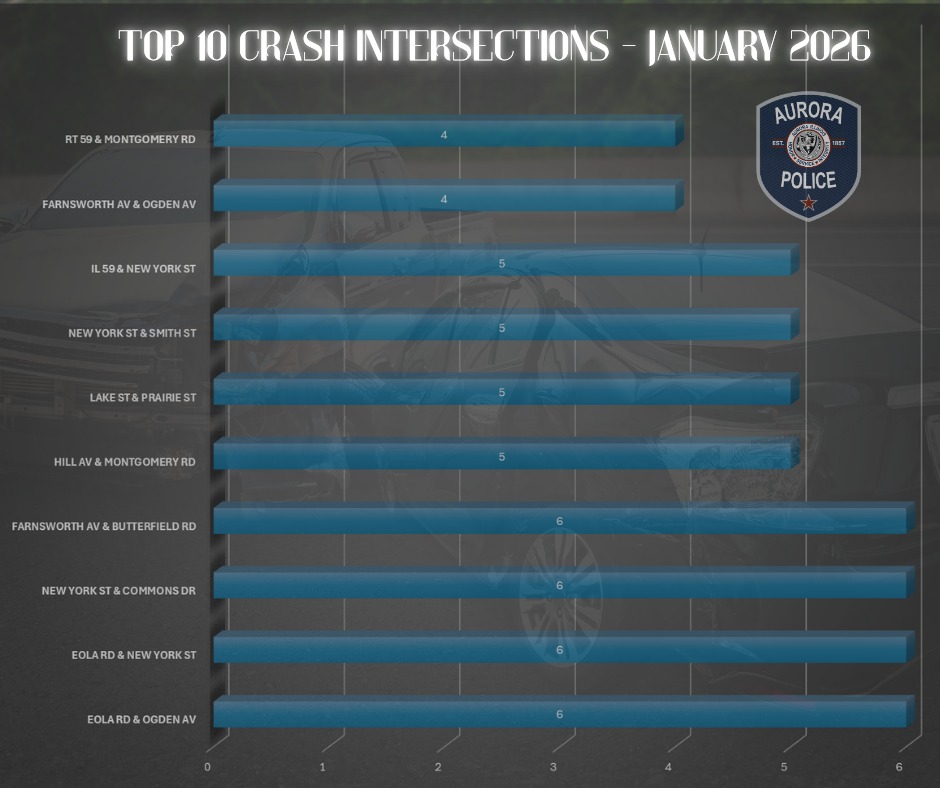
Intersections are among the most inherently hazardous points on any roadway for serious car accidents because they concentrate multiple traffic streams, competing right-of-way claims, and split-second decision-making into a confined space. Unlike straight-line travel, intersections require drivers to evaluate signal phases, anticipate turning movements, monitor cross-traffic, and account for pedestrians and bicyclists, often simultaneously.
According to the Federal Highway Administration (FHWA), a significant percentage of urban crashes occur at or near intersections, underscoring how frequently these conflict points produce collisions. Angle crashes, left-turn collisions, red-light violations, and rear-end impacts are especially common in these environments because even a minor lapse in attention or misjudgment of speed can have immediate and severe consequences.
In a growing city like Aurora, where arterial roads intersect with busy commercial corridors and residential neighborhoods, the risks associated with intersections are amplified by traffic volume, congestion, and pedestrian activity. The Aurora Police Department recently released its list of the most dangerous intersections in the city for 2026, highlighting the dangerous nature of certain areas for serious crashes.
“Every driver needs to understand that dangerous intersections aren’t just statistics, they represent real lives changed or lost,” says John J. Malm, an experienced Aurora injury attorney. “At high-crash locations across Aurora, simple behaviors like speeding, distracted driving, or failing to yield can turn a routine commute into a tragedy. Awareness and responsible driving are the first steps toward safer roads.”
Intersection Crash Trends in Aurora
City officials report that Aurora police respond to thousands of traffic crashes annually. Intersection collisions constitute a significant portion of these crashes, often involving vehicles entering intersections, red-light violations, and turning conflicts. The traffic unit uses crash trend reports to direct enforcement and public safety messaging.
Some recurring contributing factors to high crash rates include:
- High traffic volume at major arterial roads
- Speeding and failure to reduce speed approaching signals
- Distracted driving and driver inattention
- Improper lane usage and unsafe turning movements
- Red-light running and signal violations
Understanding which intersections are most dangerous is critical for both policymakers and drivers seeking to reduce the risk of collisions.
Top 10 Most Dangerous Intersections in Aurora in 2026
1. Route 59 & New York Street
This intersection ranks consistently among Aurora’s top crash locations due to heavy traffic, complex turning movements, and frequent congestion from commuter traffic and shopping centers. Congestion and turning conflicts contribute to a high number of rear-end and angle crashes.
Risk factors:
- Complexity of signal timing
- Heavy through and turning traffic
- Proximity to commercial activity
2. Eola Road & East New York Street
Often cited in city traffic safety communications, this intersection sees a high volume of collisions, particularly during peak commute hours. Multiple lanes in all directions and frequent vehicle turning movements increase exposure to conflict points.
Risk factors:
- Multiple turn lanes creating driver decision conflicts
- High weekday and weekend traffic volumes
- Signals difficult to time during peak hours
3. Farnsworth Avenue & Butterfield Road
Farnsworth Avenue is a major north–south arterial that intersects with busy east–west corridors like Butterfield Road Collisions here often involve speeding vehicles and red-light running.
Risk factors:
- High vehicle speeds
- Frequent lane changes
- Signal timing sensitivity
4. Ogden Avenue (Route 34) & Eola Road
This intersection and its vicinity are regularly listed among high-crash locations. A nearby pair of schools (Waubonsie Valley High School and Fischer Middle School) increases pedestrian and vehicle conflicts, especially during school start and dismissal times.
Risk factors:
- High pedestrian volumes
- Multiple crosswalks and turn lanes
- School zone peak flows
5. Farnsworth Avenue & Ogden Avenue
Both sides of Farnsworth Avenue at Ogden Avenue have experienced elevated crash frequency historically due to left-turn movements and speeding.
Risk factors:
- Left-turn collisions
- Speeding prior to signal
6. Lake Street & Prairie Street
Lake Street pairs with Prairie Street to form a major east-west and north-south crossing. Collisions here frequently involve rear-end and angle strikes as vehicles accelerate and decelerate during signal changes.
Risk factors:
- High commuter traffic
- Long signal cycles
- Distracted driving tendencies
7. New York Street & Commons Drive
The intersection of New York Street and Commons Drive is one of Aurora’s high-crash and high-violation locations, which is why the City installed automated red-light enforcement cameras there as part of its broader safety strategy.
This intersection combines heavy east-west commuter traffic on New York Street (IL-31 corridor) with frequent turning movements into and out of Commons Drive, a major access point for retail and commercial activity along the Fox Valley Mall area. Vehicles approaching from multiple directions must navigate complex signal phasing and lane changes, increasing the potential for right-angle collisions and rear-end crashes.
Key risk factors:
- Automated enforcement in place: Red-light cameras monitor signal compliance.
- High traffic exposure: Commuter flows and turning traffic create conflict points.
- Retail access traffic: Frequent stops and turns for shopping destinations.
8. Hill Avenue & Montgomery Road
The crossing of Hill Avenue and Montgomery Road is situated near expanding residential neighborhoods and commercial corridors on Aurora’s southwest side. While official Aurora PD crash counts for this specific intersection are not routinely published individually by month, planning documents and traffic safety assessments identify this vicinity as a priority area for future safety improvements due to existing collision patterns and insufficient crossing infrastructure.
Pedestrian safety concerns are also documented in the area because bicyclists and walkers must traverse long distances without marked crosswalks or dedicated signals, especially along Hill Avenue where vehicle speeds are relatively high.
Key risk factors:
- Limited pedestrian infrastructure: Cross-street crossings are not well marked.
- Commuter peak congestion: Morning/evening traffic intensifies turning conflicts.
- Signal coordination issues: Turning vehicles often queue through green intervals.
9. New York Street & Smith Street
The intersection of New York Street and Smith Street is a central downtown crossing where commuter traffic on New York Street interacts with local north–south traffic on Smith. Although specific crash counts for 2025-2026 are not publicly released by Aurora PD, historical reports and crash trend maps have repeatedly shown this downtown intersection among those with high overall collision rates in past years, ranking alongside other inner-city cross streets in older police data.
Traffic here includes delivery vehicles, dense local traffic, and pedestrian flows crossing New York Street, which increases exposure and collision risk. Crosswalks and signal phases attempt to balance vehicle movement with pedestrian accommodation, but conflicting movements still lead to frequent reported crashes.
Key risk factors:
- Urban traffic density: High vehicle and foot traffic volumes.
- Complex turning movements: Left and right turns across multiple lanes.
- Signal coordination demand: Frequent phase changes to serve pedestrians and vehicles.
10. Route 59 & Montgomery Road
The Route 59 and Montgomery Road intersection, where a major north–south state highway meets a busy east–west arterial, has been recognized over multiple years as one of the community’s more collision-prone intersections, particularly for severe injury and fatal crashes.
In broader crash analyses covering the past decade, this intersection appears on lists of high-severity crash locations with significant rear-end and angle collisions, driven by high approach speeds on Route 59 and multiple turn lanes at Montgomery. Drivers negotiating left turns across opposing traffic, combined with heavy commuter volumes and nearby access points, elevate the crash risk.
Key risk factors:
- High traffic volume on Route 59: A state highway corridor carrying commuters and commercial traffic.
- Severe crash history: Included on historical lists of locations with numerous serious crashes.
- Signal and speed conflicts: Fast approaches and lane-change movements.
Why These Intersections Are High Risk
Intersections become “dangerous” due to repeated conflict points where vehicles converge, turn, or cross paths. Several key contributors include:
- Signal complexity: Intersections with multiple lanes and signal phases increase confusion and decision points.
- High volumes: Peak commuter times boost crash exposure exponentially.
- Driver behavior: Speeding, red-light running, and distracted driving remain top crash contributors.
- Turning movements: Left-turn accidents often result in high-severity collisions.
Aurora police traffic unit data show that crash patterns tend to cluster around weekdays and morning/evening peaks, times when commuter behavior, school traffic, and congestion coincide.
Frequently Asked Questions about High-Risk Aurora Intersections
Q: How much of Aurora’s crash risk occurs at intersections?
A: Historically, a significant portion, over 40%, of crash events in Aurora occur at intersections, which underscores the vulnerability of these locations.
Q: Are red-light cameras helping reduce crashes?
A: Aurora has installed red-light cameras at several high-crash intersections, and city officials report that these automated enforcement tools help deter signal violations and reduce severe collision types at those locations.
Q: What time of day are crashes most common?
A: Early morning and evening commute hours see elevated crash numbers due to heavier traffic volume and driver impatience. Early afternoon school dismissal times also contribute at school-adjacent intersections.
Q: Does weather play a role in intersection crashes?
A: Yes. Snow, ice, and rain, common in Aurora winters and springs, significantly increase the risk of loss-of-control and rear-end collisions at intersections.
Q: Are pedestrians considered in crash statistics?
A: Yes. Pedestrians are involved in intersection collisions throughout the city, prompting crosswalk improvements and safety campaigns.
Contact the Top Aurora Car Accident Attorneys at John J. Malm & Associates
Intersections are crossroads not just for vehicles but for community safety. The data clearly show that Aurora’s most dangerous intersections consistently contribute to a disproportionate share of crash incidents. While enforcing traffic laws and redesigning infrastructure are essential, driver behavior remains the most critical factor in reducing collision risk.
Every driver has a role in improving roadway safety. If you or someone you know has been injured as a result of a crash at one of these high-risk intersections, it’s crucial to have an experienced Aurora car accident lawyer by your side.
Contact John J. Malm & Associates for a free consultation. Our injury attorneys will explain your rights after a crash and help you get the compensation you deserve. Together, we can work toward safer roads for Aurora residents and visitors alike.