- Free Consultation: (630) 527-4177 Tap Here to Call Us
















Why Do Stores Sometimes Have Concrete Pillars in Front of Their Entrances?


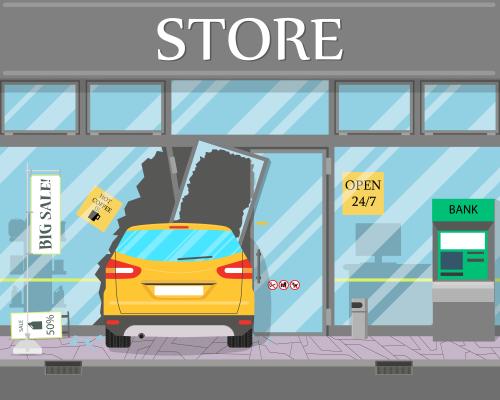
If you’ve ever walked into a grocery store, big-box retailer, bank, or restaurant and noticed short concrete posts lined up in front of the entrance, you’ve seen what are commonly called bollards. These fixed protective barriers are designed to prevent vehicles from crashing into pedestrian areas and storefronts. While they may appear simple or even decorative, bollards serve a critical safety function.
Storefront crashes are not rare, freak accidents. They happen daily across the United States and when they occur, the consequences can be catastrophic. Understanding why businesses install concrete barriers helps explain both the safety benefits and the legal implications when those protections are absent.
“Storefront crashes are far more common than most people realize. When businesses fail to take reasonable steps to protect their customers, especially in high-traffic parking areas, the consequences can be devastating. Proper safety barriers can mean the difference between a close call and a catastrophic injury.” — John J. Malm, Naperville injury attorney
What Are Bollards?
A bollard is a short, sturdy vertical post, typically made of reinforced concrete or steel, installed to prevent vehicles from entering pedestrian spaces or crashing into buildings. Bollards are commonly used:
- In front of retail store entrances
- Outside restaurants and outdoor dining areas
- Near ATMs and gas station entrances
- Around school buildings and childcare centers
- In front of government buildings and banks
Properly engineered bollards are designed to stop or significantly slow a vehicle traveling at low to moderate speeds, such as those typically occurring in parking lots.
How Common Are Storefront Crashes?
According to data compiled by the Storefront Safety Council, vehicles crash into buildings in the United States approximately 100 times per day. Their research estimates that these crashes result in:
- Approximately 16,000 injuries per year
- Roughly 2,600 fatalities annually
These figures highlight that vehicle-into-building incidents are not isolated events. Instead, they represent a recurring safety hazard in commercial environments.
National news investigations have also documented that storefront crashes occur with troubling frequency in retail and restaurant settings, particularly in parking lots where vehicles are positioned directly in front of entrances.
Why Do These Crashes Happen?
Most storefront crashes are not intentional. The leading causes include:
1. Pedal Misapplication
Pedal misapplication, pressing the accelerator instead of the brake, is one of the most common causes of vehicle-into-building crashes. Research from the National Highway Traffic Safety Administration (NHTSA) indicates that pedal error contributes to thousands of crashes annually nationwide.
This type of mistake is particularly common:
- In parking lots
- During low-speed maneuvers
- When drivers are startled or distracted
- Among elderly drivers
2. Parking Lot Design
Many commercial properties place parking spaces directly facing storefront glass. Without protective barriers, a low-speed acceleration error can result in a vehicle entering the building.
Contributing design risks include:
- Angled parking directly toward entrances
- Sloped pavement that directs vehicles toward storefronts
- Lack of wheel stops or curbs
- No physical separation between vehicles and pedestrian areas
3. Distracted or Impaired Driving
Cell phone use, intoxication, and fatigue can all increase the risk of a driver losing control near commercial entrances.
4. Medical Emergencies
Sudden medical events, such as seizures or cardiac episodes, can also cause drivers to unintentionally accelerate into buildings.
How Bollards Improve Safety
Concrete or steel bollards serve several important safety functions:
- Vehicle intrusion prevention: They physically block a car from entering pedestrian zones.
- Energy absorption: Properly installed bollards can absorb and redistribute impact force.
- Pedestrian protection: They create a protective buffer between moving vehicles and people entering or exiting a store.
- Property damage reduction: They reduce structural damage to storefronts.
Crash-rated bollards are engineered to meet impact standards and are often installed according to safety guidelines set by engineering and building authorities.
While no barrier guarantees zero injury, studies show that physical barriers significantly reduce the severity of impact and likelihood of fatalities in low-speed crashes.
Restaurants and Outdoor Dining Areas: A Growing Risk
With the expansion of outdoor dining and curbside pickup areas, restaurants have become particularly vulnerable to storefront crashes.
Outdoor patios often place diners within feet of moving vehicles. Without protective barriers:
- A minor parking mistake can result in multiple serious injuries.
- Families with children are exposed to unpredictable vehicle movement.
- Servers and staff working outside are at risk.
The Storefront Safety Council has repeatedly emphasized that retail and restaurant locations represent a significant portion of vehicle-into-building incidents.
When Are Bollards Legally Required?
Illinois building codes and municipal ordinances vary, but some local jurisdictions require protective barriers in specific high-risk areas, such as:
- Gas stations
- Convenience stores
- ATM installations
- Buildings with parking directly adjacent to entrances
Even when bollards are not explicitly required by code, property owners may still have a duty under Illinois premises liability law to address foreseeable risks. If vehicle intrusion is foreseeable, especially in areas with prior incidents or high pedestrian traffic, failing to install reasonable protective measures could raise liability concerns.
Illinois Premises Liability and Storefront Safety
Under Illinois law, property owners owe a duty of reasonable care to lawful visitors. This includes maintaining safe premises and protecting customers from foreseeable harm.
If a vehicle crashes into a store and injures patrons, liability may extend beyond the driver. Courts may examine whether:
- The business knew or should have known about prior vehicle intrusion risks.
- Parking lot design created an unreasonable danger.
- Protective barriers were feasible and industry-standard.
- The absence of bollards contributed to the severity of injuries.
In some high-profile cases nationwide, substantial verdicts and settlements have been awarded when property owners failed to implement protective barriers in high-risk locations.
The Cost of Failing to Install Protective Barriers
The financial and human cost of storefront crashes can be devastating:
- Emergency medical treatment and surgeries
- Long-term rehabilitation
- Permanent disability
- Loss of life
- Structural property damage
- Business interruption losses
Beyond direct injury costs, businesses may face:
- Insurance premium increases
- Litigation expenses
- Reputational damage
- Regulatory scrutiny
Installing bollards is often far less expensive than defending a catastrophic injury lawsuit.
Frequently Asked Questions about Bollards in Front of Stores
Q: Are bollards required by law in Illinois?
A: Not universally. Requirements depend on local building codes and the type of property. However, even where not mandated, property owners may still be responsible if failing to install barriers creates a foreseeable danger.
Q: Do bollards actually stop vehicles?
A: Crash-rated bollards are specifically engineered to withstand impact from vehicles traveling at low-to-moderate speeds, particularly those common in parking lot settings.
Q: Who is responsible if a car crashes into a store?
A: Potentially responsible parties include:
- The negligent driver
- The property owner
- The business tenant
- The property management company
Liability depends on the facts, including whether reasonable safety measures were in place.
Q: Can a business be sued for not having barriers?
A: Yes, in some circumstances. If it can be shown that the risk of vehicle intrusion was foreseeable and reasonable safety measures were not implemented, a premises liability claim may be possible.
Contact the Trusted Illinois Storefront Crash Lawyers at John J. Malm & Associates
Concrete pillars and bollards are not merely architectural features, they are critical safety devices designed to protect people from predictable and preventable harm. With vehicle-into-building crashes occurring daily nationwide, businesses that fail to implement reasonable protective measures may be exposing customers to unnecessary risk.
If you or a loved one has been injured in a storefront crash or restaurant vehicle intrusion in Illinois, you deserve answers and accountability. These cases require immediate investigation, preservation of surveillance footage, analysis of parking lot design, and evaluation of whether appropriate protective barriers were installed.
Our firm has extensive experience handling serious premises liability and vehicle-related injury cases. We understand how to identify all responsible parties and aggressively pursue the full compensation you deserve.
Contact John J. Malm & Associates today for a free consultation. Let us evaluate your case, protect your rights, and fight for the recovery you need to move forward. Your safety matters and when businesses fail to prioritize it, we are here to help.