- Free Consultation: (630) 527-4177 Tap Here to Call Us
















Is It Safer to Ride a Motorcycle in the City or on the Highway?


It’s one of the questions every motorcyclist eventually asks: whether consciously or not. You’re weighing your route, thinking about traffic, calculating risk. Should you stick to city streets where speeds are lower, or push out onto the highway where flow is more predictable? The answer is more nuanced than most riders expect, and the statistics may surprise you. Understanding where motorcycle accidents actually happen, and why, can help you make smarter decisions every time you get on your bike.
What the data makes clear is this: motorcycle riding is inherently dangerous in ways that cars simply are not. According to the National Highway Traffic Safety Administration (NHTSA), there were 6,228 motorcyclists killed in the United States in 2024, one of the highest death counts since NHTSA began keeping records in 1975. Although motorcycles represent only about 3% of registered vehicles in the country, riders account for more than 16% of all traffic fatalities. Per vehicle mile traveled, motorcyclists are approximately 27 times more likely to die in a crash than passenger car occupants. Those numbers frame everything that follows.
Attorney John J. Malm and his team at John J. Malm & Associates have seen firsthand the devastating consequences of motorcycle crashes in DuPage County and throughout Northern Illinois, from intersection collisions on city streets to catastrophic highway impacts. The firm has secured significant results for injured riders, including a $435,000 settlement for a motorcyclist who suffered serious orthopedic and spinal injuries after a driver pulled out in front of him, and a $495,000 settlement in a roadway defect case against the City of Chicago where a pavement defect caused riders to be thrown from their bike.
The Case Against City Riding: Why Urban Streets Are More Dangerous Than You Think
Most riders assume the highway is the more dangerous environment: faster speeds, larger trucks, fewer exits. But the data tells a very different story. The research is remarkably consistent: urban environments are where the majority of deadly motorcycle crashes occur.
According to NHTSA data, 92% of motorcyclist fatalities occur on non-interstate roads. That means the overwhelming share of deadly crashes happen not on expressways and interstates, but on the arterial roads, intersections, and surface streets that define city riding. NHTSA data from 2022 confirms that 66% of motorcycle fatalities occurred in urban areas, compared to just 34% in rural areas.
Here’s what makes city riding so dangerous:
- Intersections are the deadliest single location for motorcyclists. Approximately 36–42% of fatal motorcycle crashes involving another vehicle happen at intersections, where left-turn collisions are especially lethal. These occur when a car turns left directly into the path of an oncoming motorcycle, often because the driver simply failed to notice the rider.
- Constant stopping and starting increases the risk of rear-end collisions, especially in heavy traffic where following distances shrink.
- Unpredictable driver behavior: sudden lane changes, distracted driving, rideshare vehicles pulling over without warning is far more common in city environments.
- Road hazards are more frequent. Potholes, manhole covers, gravel, and debris are concentrated on urban surface streets, and they pose an outsized threat to two-wheeled vehicles.
- Pedestrians and cyclists add additional complexity and unpredictability that doesn’t exist on controlled-access highways.
- Driver “attention bias” plays a deadly role: studies show that drivers in urban areas often fail to mentally register motorcycles because they aren’t actively looking for them, their eyes and brains are filtering for cars.
Research also shows that most motorcycle accidents occur at speeds below 30 mph, the typical speed of urban surface streets. While low-speed crashes are less likely to be fatal than high-speed crashes, the sheer frequency of close calls and multi-vehicle conflicts in cities means the overall crash rate is higher.
The Case for City Riding: Where Highways Carry Their Own Risks
Despite the statistics favoring highway riding in terms of raw crash frequency, the highway is far from risk-free and when things go wrong at highway speeds, the consequences are catastrophic. The core tradeoff is this: city riding brings more frequent accidents, while highway crashes, when they do occur, tend to be more severe. At 70 miles per hour, the margin for error essentially disappears.
Highway-specific risks for motorcyclists include:
- Higher crash severity. When accidents happen at highway speeds, injuries are dramatically more serious. There is little protective structure on a motorcycle, and impact forces at high speed are often unsurvivable.
- Road debris. Tire tread, gravel, and other debris on highways can cause a motorcyclist to lose control with almost no warning at speed.
- Wind and weather. Crosswinds and sudden weather changes that are manageable at 30 mph become genuinely dangerous at 70 mph.
- Drowsiness and long distances. Highway monotony contributes to fatigue, which impairs reaction time and judgment.
- Aggressive merging and lane changes. Larger vehicles like semi-trucks and SUVs may not see a motorcycle during a merge, and at highway speeds, there is almost no time to react.
- Limited emergency access. If a rider goes down on a highway, emergency services may take longer to arrive than on a city street.
It’s also worth noting that interstates, though statistically safer, are not uniformly so. Certain corridors, particularly I-55 and I-88, which run through and around the Naperville area, carry heavy truck traffic and present their own hazards for motorcyclists navigating alongside commercial vehicles.
What the Numbers Actually Tell Us: The Verdict
When all the data is weighed together, highways are statistically safer than city streets for motorcycle riders in terms of crash frequency. According to NHTSA figures, only 8–10% of fatal motorcycle crashes in recent years occurred on interstates, meaning roughly 90% of deadly crashes happened on non-highway roads.
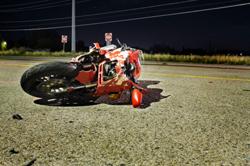
That said, “statistically safer” doesn’t mean “safe.” And it comes with a critical caveat: when highway crashes do happen, they are more likely to be fatal or catastrophic. The lower frequency of highway crashes is offset by significantly higher severity when they do occur.
The takeaway for Illinois riders is that the type of road is only one risk factor among many. Where and when you ride, combined with your experience, protective gear, sobriety, and situational awareness, matters just as much as whether you’re on a city street or an expressway. Riders in DuPage County and the Naperville metro area face both environments: dense suburban intersections where left-turn crashes are common, and major highways where speed amplifies every mistake.
Tips for Safer Riding in Both Environments
Whether you’re navigating Naperville’s downtown grid or merging onto I-88, these practices can reduce your risk:
- Wear full protective gear every ride. Helmets, jackets with armor inserts, gloves, and appropriate boots significantly reduce injury severity in a crash.
- Take a Motorcycle Safety Foundation (MSF) course. Formal training equips riders with emergency braking and evasion techniques that can be life-saving in crisis moments.
- Ride defensively at intersections. Slow your approach, make eye contact with drivers when possible, and never assume you’ve been seen.
- Increase your following distance in city traffic. This gives you more time to react to sudden stops, door openings, or merging vehicles.
- Check highway blind spots constantly. Be especially cautious around large trucks, and stay out of the no-ride zone beside and behind semis.
- Avoid riding at night when fatigued. Alcohol-impaired drivers and reduced visibility compound the risk for motorcyclists after dark.
- Keep your headlights on at all times. NHTSA recommends using high beams during the day to improve visibility to other drivers.
Frequently Asked Questions about Motorcycle Accidents
Q: Are highways or city streets more dangerous for motorcycle riders in Illinois? A: Statistically, city streets produce more motorcycle crashes and fatalities than highways. NHTSA data consistently shows that more than 90% of fatal motorcycle crashes occur on non-interstate roads, with intersections being the single most dangerous location. However, highway crashes tend to be more severe due to higher speeds. The safest approach is to ride defensively in both environments.
Q: What is the most dangerous type of motorcycle crash? A: Left-turn collisions, where a car turns directly into the path of an oncoming motorcycle, are among the most deadly and most common. They typically occur at urban intersections and are caused by drivers failing to see or correctly judge the speed of the oncoming rider.
Q: Does wearing a helmet make a difference in a crash? A: Absolutely. NHTSA research has shown that helmets have saved thousands of lives over recent decades. In 2016 alone, over 1,800 fatalities were avoided due to helmet use. Although Illinois does not have a universal helmet law for adult riders, wearing one dramatically reduces the risk of fatal head injuries.
Q: Who is at fault when a car turns left and hits a motorcycle? A: In most cases, the turning driver bears primary responsibility for failing to yield the right of way. Illinois’s modified comparative negligence law allows injured riders to recover compensation as long as they are found to be less than 51% at fault. Even if a rider is partially responsible, they may still recover damages proportional to the other party’s fault.
Q: What should I do immediately after a motorcycle accident in Naperville or DuPage County? A: Call 911, seek medical attention even if you feel okay, photograph the scene and all vehicle damage, get the other driver’s insurance and contact information, and speak with an experienced Illinois motorcycle accident attorney before giving any recorded statement to an insurance company.
Q: Can I recover damages if the at-fault driver is uninsured? A: Yes. You may be able to file a claim through your own uninsured motorist (UM) coverage. John J. Malm & Associates recently recovered a $260,000 settlement for a motorcyclist who was struck by a hit-and-run driver in Addison, Illinois, obtaining the full available policy limits through the client’s uninsured motorist carrier.
Injured in a Motorcycle Accident? Don’t Face It Alone. Contact the Award-Winning Illinois Motorcycle Accident Attorneys at John J. Malm & Associates
Whether you were riding city streets or a highway, a motorcycle accident can change your life in an instant. Medical bills mount, income disappears, and insurance companies, representing the driver, the municipality, or their own interests, work quickly to minimize what they pay you. Illinois law gives you the right to fight for full and fair compensation, but navigating that fight without an experienced advocate is an uphill battle.
At John J. Malm & Associates, our top-rated Naperville motorcycle injury attorneys have spent decades fighting for motorcycle accident victims throughout DuPage County and Northern Illinois. We understand the specific hazards riders face on both city streets and Illinois highways, and we know how to build the kind of compelling, evidence-driven cases that get results. With over 100 years of combined litigation experience and a proven track record of multimillion-dollar recoveries, our firm prepares every case as if it’s going to trial because that commitment is exactly what drives results.
If you or a loved one has been seriously injured in a motorcycle accident in Naperville or the surrounding area, contact John J. Malm & Associates today for a free consultation. Call our office, reach out through our website at malmlegal.com, or visit us at our Naperville or St. Charles location. There is no fee unless we recover for you, and the sooner you call, the sooner we can start protecting your rights.