- Free Consultation: (630) 527-4177 Tap Here to Call Us
















The Physics Behind E-Bike vs. Pedestrian Crashes


It begins quietly. A warm June afternoon. A shaded path winding through a neighborhood park. A couple walking shoulder to shoulder. A jogger approaching from the opposite direction. A child wobbling forward on a scooter. Then, almost without sound, an electric bicycle appears.
Twenty miles per hour doesn’t feel fast in a car. But on a shared path where people stroll, pause, and drift unpredictably, it can feel sudden. And when something goes wrong, the consequences unfold in seconds.
This is the quiet shift happening across cities and suburbs as spring and summer approaches. Electric bicycles, heavier, faster, and increasingly common, are transforming how people move. But they are also changing the physics of everyday bicycle accidents in ways many riders, pedestrians, and even policymakers don’t fully appreciate.
Because when an e-bike strikes a pedestrian, the human body becomes the crumple zone.
The Moment Where Physics Takes Over
Engineers and accident reconstruction experts use a concept called delta-V, or change in velocity, to understand how injuries occur during crashes. Delta-V measures how quickly the body accelerates during an impact. The faster the change, the greater the force applied to the human body.
In car crashes, seatbelts, airbags, and vehicle structure help absorb and spread out that force. These systems reduce delta-V and increase survivability. Pedestrians, by contrast, have none of those protections.
Illinois e-bike accident attorney John J. Malm explains: “When you analyze these crashes from an engineering standpoint, an e-bike behaves more like a small motorcycle than a traditional bicycle. The added weight and speed increase delta-velocity, and that’s what leads to catastrophic injuries.”
That’s because e-bikes combine two key factors: mass and speed. A traditional bicycle weighs roughly 20 to 30 pounds. Many e-bikes weigh 50 to 80 pounds, and cargo models can exceed 100 pounds. Add a rider, and the total moving mass often reaches 300 pounds or more.
At the same time, speeds increase:
- Traditional bicycles: 8–15 mph
- Class 1 and 2 e-bikes: up to 20 mph
- Class 3 e-bikes: up to 28 mph
Because kinetic energy increases with the square of velocity, even modest increases in speed dramatically increase impact force. That means a collision at 20 mph isn’t just slightly worse than one at 12 mph, it can involve two to three times the force. At 28 mph, those forces become even more significant.
And unlike a car crash, where energy is absorbed by metal and safety systems, a pedestrian absorbs nearly all of it.
The Biomechanics of an E-Bike Collision
From a biomechanics standpoint, pedestrian collisions rarely involve a single impact. Instead, they typically involve two separate impacts. The first occurs when the e-bike strikes the pedestrian’s lower body: often the legs, hips, or pelvis. This impact transfers energy and rotates the body forward.
The second occurs when the pedestrian falls to the ground. This secondary impact frequently causes:
- Traumatic brain injuries
- Shoulder fractures
- Spinal injuries
- Internal bleeding
This two-stage impact dramatically increases injury severity. The first collision transfers energy. The second often produces the most serious injuries. Unlike drivers or even cyclists, pedestrians cannot dissipate energy. The human body absorbs nearly 100 percent of the force.
As John J. Malm explains:
“When an e-bike strikes a pedestrian, there’s nowhere for that energy to go. The pedestrian absorbs the entire force. That’s why even moderate-speed collisions can be catastrophic or fatal.”
Four Real-World Spring and Summer Scenarios
These collisions don’t happen in extreme conditions. They happen in everyday spring and summer moments.
A pedestrian drifts slightly into a shared path.
An e-bike approaches quietly at 22 mph.
Limited reaction time.
Impact.
A pedestrian crosses a quiet residential street.
An e-bike appears from behind parked cars traveling 18 mph.
Collision.
A shopper exits a storefront onto a sidewalk.
An e-bike traveling 15 mph cannot stop in time.
Impact.
A pedestrian enters a crosswalk.
An e-bike traveling 20–25 mph fails to yield.
Collision.
Each of these scenarios occurs regularly during warmer months. And each involves significant delta-V forces. Even speeds below 28 mph can produce severe injuries. Because when the human body absorbs the full impact, survivability decreases rapidly.
Why Pedestrians Face the Greatest Risk
Drivers benefit from:
- Airbags
- Seatbelts
- Crumple zones
- Structural protection
Motorcycle riders may benefit from helmets and protective gear. Cyclists face greater risk but may still dissipate some energy through motion or deflection. Pedestrians have none of these protections.
From a biomechanical standpoint, pedestrians experience the most dangerous scenario: direct force transfer combined with secondary ground impact. Once acceleration forces exceed survivable thresholds, catastrophic injuries become likely.
Visualizing the Physics
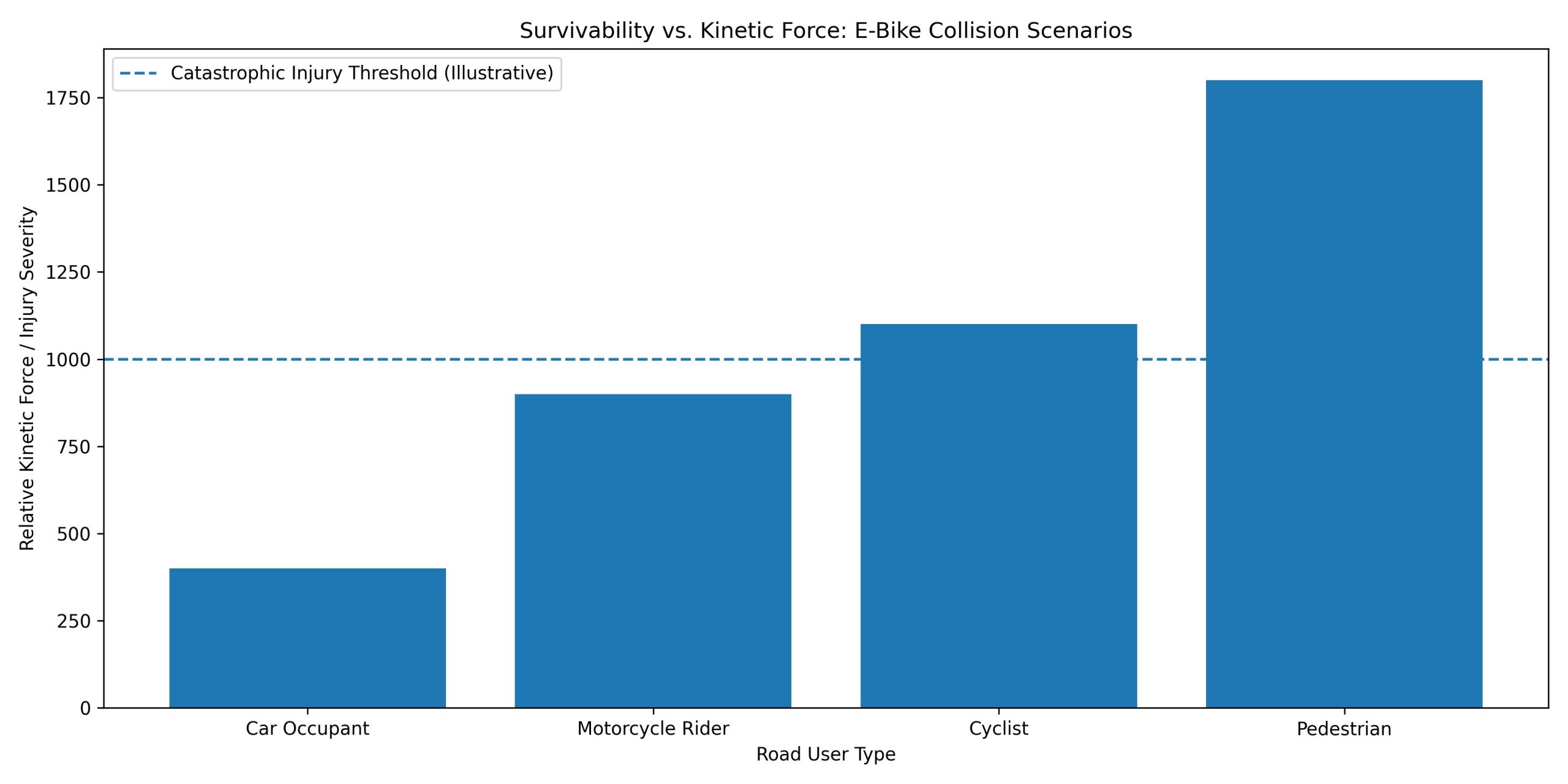
The chart below illustrates how different road users experience impact forces and survivability.
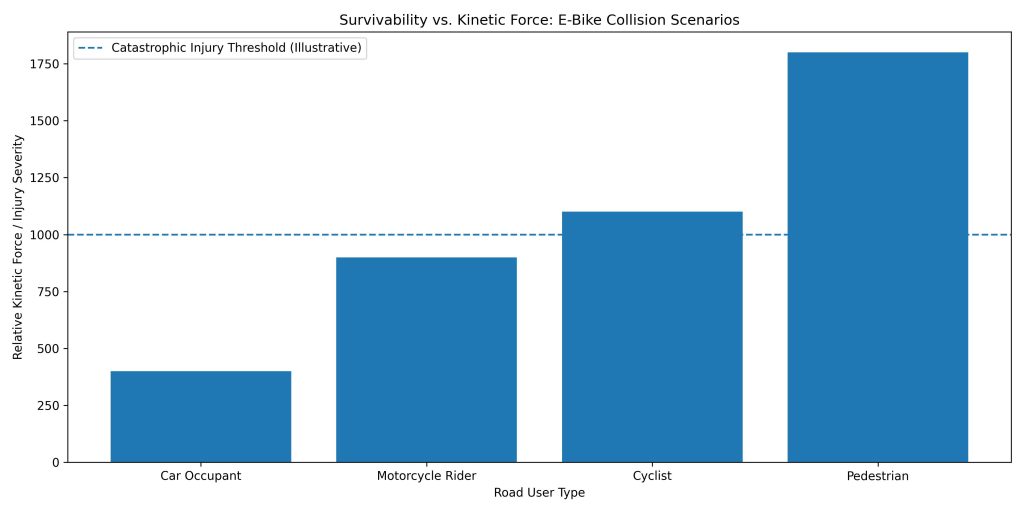
The comparison highlights an important reality:
- Car occupants benefit from structural protection
- Motorcycle riders face elevated risk
- Cyclists face increased injury severity
- Pedestrians absorb nearly all of the force
This is why pedestrian collisions often produce the most serious injuries.
Why Spring and Summer Increases the Risk
Both spring and summer changes behavior. More people walk outdoors. Bike paths fill. Neighborhood streets become shared spaces. At the same time, e-bike usage increases.
These trends create more interaction between riders and pedestrians, and more opportunities for collisions. E-bikes also operate quietly, reducing warning signals. Pedestrians often don’t hear them approaching.
Why E-Bikes Deserve More Scrutiny
E-bikes occupy a unique space between bicycles and motor vehicles. But safety regulations and infrastructure haven’t fully adapted.
Unlike motorcycles, e-bikes often require:
- No license
- No insurance
- No formal training
Yet they travel at speeds approaching motorized vehicles, often in pedestrian environments.
Additional concerns include:
- Heavier frames increase stopping distance
- Electric acceleration reduces reaction time
- Quiet operation reduces warning signals
- Mixed-use paths increase interaction
These factors create a growing safety concern.
Cities are beginning to explore:
- Speed limits on shared paths
- Infrastructure improvements
- Rider education
- Equipment standards
But adoption is growing faster than policy.
The Quiet Shift in Summer Streets
E-bikes offer enormous benefits: convenience, accessibility, and mobility. They reduce traffic congestion and provide efficient transportation. But they also change the physics of everyday life.
Heavier. Faster. Quieter. And when collisions occur, those differences matter.
As John J. Malm explains:
“E-bikes are changing how we think about bicycle safety. These aren’t low-speed bicycles anymore. When collisions occur, the forces involved can be life-changing.”
Frequently Asked Questions About E-Bike vs. Pedestrian Crashes
Q: Who is at fault in an e-bike vs. pedestrian accident?
A: Fault in an e-bike versus pedestrian crash depends on negligence, specifically, who failed to exercise reasonable care under the circumstances. E-bike riders must follow traffic laws, yield to pedestrians in crosswalks, and maintain safe speeds, especially on shared paths. Pedestrians, however, also have responsibilities, such as obeying traffic signals and avoiding sudden or unpredictable movements into traffic.
Q: Are e-bike riders subject to the same laws as traditional bicyclists?
A: Generally, yes. In Illinois, most e-bike riders are subject to the same rules of the road as traditional bicyclists. However, the classification of the e-bike (Class 1, 2, or 3) can affect where it is legally allowed to operate and how fast it can travel.
Q: Can a pedestrian sue an e-bike rider after an accident?
A: Yes. If a pedestrian is injured due to an e-bike rider’s negligence, such as speeding, distracted riding, or failing to yield, the pedestrian may pursue a personal injury claim.
Q: What if the e-bike rider was working for a delivery service?
A: If the e-bike rider was working at the time of the crash, for example, delivering food or packages, their employer may be held liable under the legal doctrine of respondeat superior. This can significantly impact the value of a claim, as companies often carry larger insurance policies than individual riders.
Contact the Top Illinois Injury Attorneys at John J. Malm & Associates for Help After an E-Bike Pedestrian Accident
E-bike versus pedestrian accidents often involve serious injuries, complicated liability issues, and insurance challenges that can quickly overwhelm victims and their families. Determining fault, preserving evidence, and negotiating with insurers requires a strategic and experienced approach. At John J. Malm & Associates, we understand how to investigate these cases, identify all responsible parties, and aggressively pursue the compensation you deserve.
If you or a loved one has been injured in an e-bike accident, do not wait to get the guidance you need. Contact our office today for a free consultation. We will evaluate your case, explain your legal options, and fight to protect your rights every step of the way.